How to Read Part of an Integer
Excel INT Office
Summary
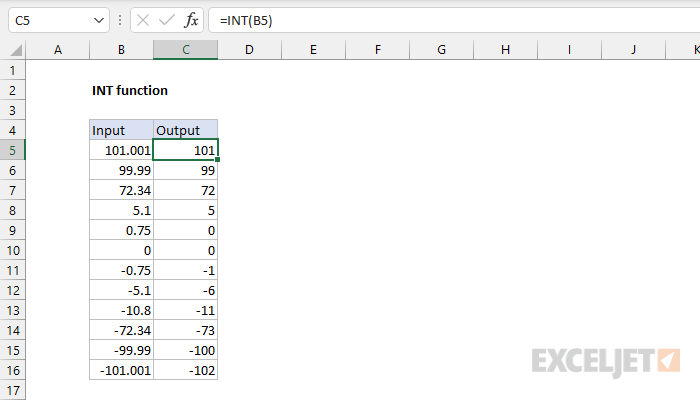
The Excel INT function returns the integer part of a decimal number by rounding down to the integer. Note that negative numbers get more negative. For instance, while INT(10.8) returns 10, INT(-10.8) returns -11.
Purpose
Get the integer office of a number by rounding downwards
Return value
The integer role of the number subsequently rounding down
Arguments
- number - The number from which you lot want an integer.
Usage notes
The INT function returns the integer function of a decimal number by rounding down to the integer. It is important to empathize that the INT office returns the integer part of a decimal number, after rounding down. Ane issue of this beliefs is that negative numbers get more negative. For example, while INT(ten.eight) returns 10, INT(-10.viii) returns -11. To render an integer by truncating decimals, see the TRUNC function.
The INT office takes just one statement, number, which should be a numeric value. INT returns a #VALUE! error if number is not a numeric value. If number is already a whole number, INT has no effect.
Examples
When numbers are positive, the INT function rounds down to the side by side lowest whole number:
= INT ( three.25 ) // returns three = INT ( 3.99 ) // returns 3 = INT ( iii.01 ) // returns iii
Notice INT rounds positive numbers down toward zero. With negative numbers, INT rounds down away from naught:
= INT ( - three.25 ) // returns -4 = INT ( - 3.99 ) // returns -4 = INT ( - 3.01 ) // returns -4
INT vs. TRUNC
INT is like to the TRUNC office because they both tin can return the integer office of a number. Yet, TRUNC simply truncates a number, while INT actually rounds a number down to an integer. With positive numbers, and when TRUNC is using the default of 0 for num_digits, both functions return the same results. With negative numbers, the results tin be different. INT(-three.1) returns -4, because INT rounds downwardly to the lower integer. TRUNC(-3.1) returns -iii. If y'all merely want the integer part of a number, you lot should use TRUNC.
Rounding functions in Excel
Excel provides a number of functions for rounding:
- To round normally, utilise the ROUND function.
- To round to the nearest multiple, use the MROUND function.
- To round down to the nearest specified identify, use the ROUNDDOWN function.
- To round downwardly to the nearest specified multiple, employ the FLOOR function.
- To circular upwardly to the nearest specified place, use the ROUNDUP role.
- To round up to the nearest specified multiple, use the CEILING part.
- To round down and return an integer only, employ the INT function.
- To truncate decimal places, use the TRUNC function.
Notes
- INT returns a #VALUE! mistake if number is not a numeric value.
- Use the INT office to get an integer from a number by rounding.
- Use the TRUNC function to return an integer past truncating.
INT formula examples
Well-nigh of the work in this formula is washed by the TEXT part, which applies a custom number format for hours and minutes to a value created by subtracting the starting time date from the end date. TEXT(C5-B5,"h"...

The DATEDIF office (Date + Dif) is a bit of an anomaly in Excel. A compatibility role that comes originally from Lotus one-ii-3, Excel will not aid supply arguments when the function is entered. However, DATEDIF...
Excel handles dates and time using a scheme in which dates are serial numbers and times are fractional values. For instance, June one, 2000 12:00 PM is represented in Excel as the number 36678.five, where 36678 is the date...
To start off, the formula in C5 is: =INT($B5/C$iv) This formula divides the amount in column B past the denomination in C4 (100) and discards the remainder using the INT function. The formulas in cavalcade C are simpler...
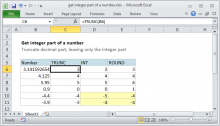
With TRUNC, no rounding takes place. The TRUNC function just slices off the decimal part of the number with default settings. TRUNC actually takes an optional 2nd argument to specify the precision of truncation,...
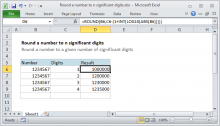
This can be an intimidating formula if y'all don't have a skilful background in math, merely let's work through it step-by-step. First, when you have a formula like this where i function (in this example Circular) wraps around...
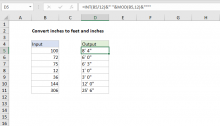
This formula converts a numeric value in inches to text representing the same measurement in inches and feet. To get the value for feet, the INT part is used like this: =INT(B5/12)&"' " Inside INT,...
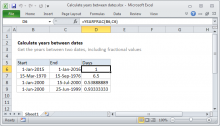
The YEARFRAC function returns a decimal number representing the fractional years between ii dates. For case: =YEARFRAC("1-Jan-2019","one-January-2020") // returns 1 =YEARFRAC("1-January-2019",...
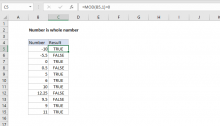
In this example, the goal is to examination if a numeric value is a whole number. There are several ways to go about this. One of the easiest ways is to use the Modernistic role with a divisor of 1. Whatsoever whole number divided by 1...
Related videos
In this video we look at how to apply a feature called Evaluate Formula to solve complex formulas 1 step at a time.
In this brief video, we look at how to debug a formula using the F9 key. If you lot work with formulas a lot, this is ane of the most useful skills you can learn.
Related functions
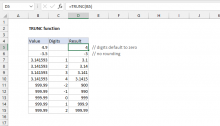
The Excel TRUNC role returns a truncated number based on an (optional) number of digits. For example, TRUNC(four.nine) volition return 4, and TRUNC(-iii.5) will return -3. The TRUNC part does no rounding, it simply truncates as specified.
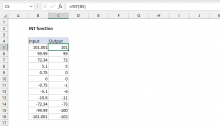
The Excel INT office returns the integer role of a decimal number by rounding down to the integer. Notation that negative numbers become more negative. For instance, while INT(10.8) returns 10, INT(-ten.8) returns -eleven.
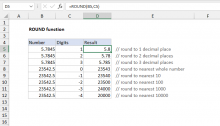
The Excel ROUND role returns a number rounded to a given number of digits. The Round office can round to the right or left of the decimal indicate.
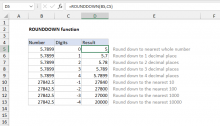
The Excel ROUNDDOWN function returns a number rounded downwards to a given number of places. Unlike standard rounding, where merely numbers less than v are rounded down, ROUNDDOWN rounds all numbers down.
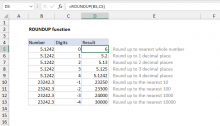
The Excel ROUNDUP function returns a number rounded upwardly to a given number of decimal places. Unlike standard rounding, where only numbers less than 5 are rounded downwards, ROUNDUP rounds all numbers up.
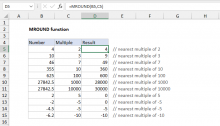
The Excel MROUND function returns a number rounded to a given multiple. MROUND volition circular a number up or downwards, depending on the nearest multiple.
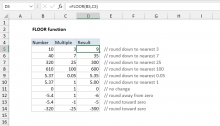
The Excel FLOOR part rounds a given number down to the nearest specified multiple. Flooring works similar the MROUND part, but Floor always rounds downward.
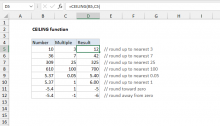
The Excel CEILING function rounds a given number up to the nearest specified multiple. CEILING works like the MROUND function, simply CEILING always rounds upwards.
Download 100+ Important Excel Functions
Get over 100 Excel Functions yous should know in i handy PDF.
Excel video training
Quick, clean, and to the point.
Source: https://exceljet.net/excel-functions/excel-int-function
Belum ada Komentar untuk "How to Read Part of an Integer"
Posting Komentar