How Would All in the Family Be Received Now?
The Show That Changed Television Forever
All in the Family was the first program to genuinely reckon with the cultural upheaval of 1960s America. TV would never exist the same.
Adjusted from Rock Me on the Water, HarperCollins Publishers, 2021.
When CBS first placed All in the Family on the air, on January 12, 1971, it irrevocably transformed television. Later on a shaky offset season in which it struggled to find an audience, the show prospered, rising to become No. i in the ratings for v consecutive years, a record unmatched at the time. All in the Family allowable national attention to a caste almost impossible to imagine in today'southward fractionated entertainment landscape. Archie Bunker'south catchwords—stifle, meathead, and dingbat—all became national autograph. Scholars earnestly debated whether the show punctured or promoted bigotry.
Its success not only helped lift The Mary Tyler Moore Bear witness, M*A*S*H, and the other great topical comedies of the early 1970s, but also cemented the thought that television could be used to comment meaningfully on the lodge around information technology—an idea the networks had uniformly rejected throughout all the upheaval of the 1960s. That legacy—the determination to connect the medium to the moment—reverberates through shows as various as Fleabag, Atlanta, Breaking Bad, The Wire, and endless others. The night that CBS initially aired All in the Family was the first step on the road toward the Peak TV that we are living through today.
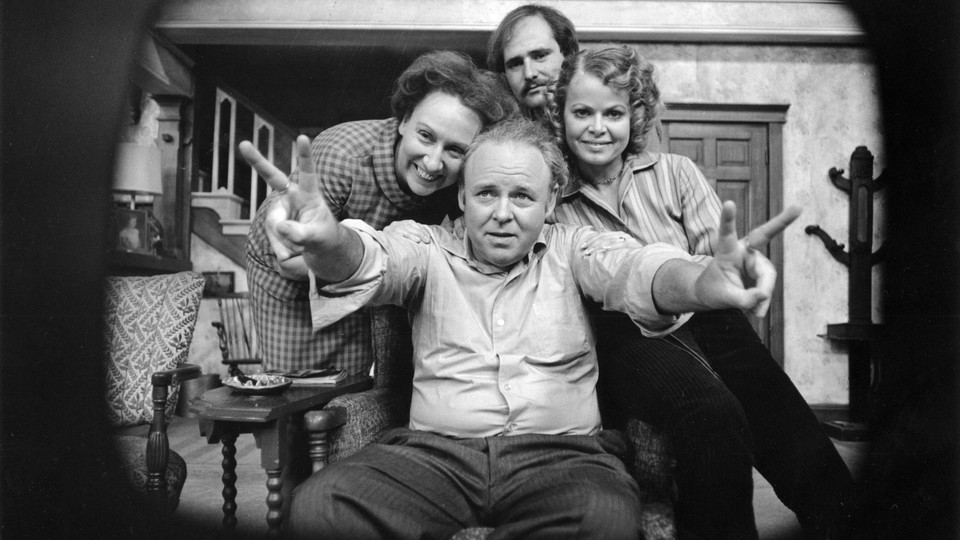
All in the Family condensed the "generation gap" of the 1960s into a single living room. Information technology pitted Mike Stivic, a long-haired liberal, and his married woman, the bubbly Gloria, against Gloria'due south father, Archie Bunker, a reactionary bigot and Richard Nixon–loving dockworker—as Edith, the daffy but benevolent wife and mother, looked on. Incarnated past a stellar cast and energized by vivid writing and directing, it became a tv landmark, widely lauded as ane of the greatest and most influential shows ever.
Initially, though, it was something of a phenomenon that All in the Family reached the air at all. Before CBS bought it, ABC had rejected it twice. And before All in the Family, shows that tried to reach more than relevance had almost all failed, mostly considering they were besides laden with good intentions to concenter an audition. That All in the Family unit not simply reached the air merely prospered was the result of two men: Norman Lear, its staunchly liberal creator, and Robert D. Woods, the conservative president of CBS, who put it on the schedule. That act revolutionized television, simply both men were unlikely revolutionaries.
Norman Lear was the son of a homo whose dreams dissolved quickly just whose resentments outlived him in the work of his son. Herman Lear was a pocket-size-time salesman and entrepreneur, and a fountain of dubious get-rich-quick schemes. His wife, Jeanette, according to Norman, was self-absorbed, discontented, and, like her hubby, volatile. Later, they would go Lear's early models for Archie and Edith Bunker. Throughout his babyhood in Connecticut and Brooklyn, Lear's parents immersed him in an environs of barely controlled chaos. The two of them, Lear would often say, "lived at the ends of their nerves and the tops of their lungs." At the peak of statement, the veins in his neck jutting, Lear's male parent would beat his fists against his chest and bellow at Lear's mother, "Jeanette, stifle yourself."
Like many children of the Great Depression, Lear found direction and structure in the armed services. After drifting through a few semesters at Emerson Higher, in Boston, he enlisted in the Army Air Strength following Pearl Harbor and flew dozens of bombing missions over Germany. After a few years working as a Broadway press amanuensis and, later, for his father, Lear made a determination that proved a turning signal: He loaded his married woman and infant daughter into a 1946 Oldsmobile convertible and pointed it toward Los Angeles. In that location, he hoped for a fresh get-go, merely struggled to detect piece of work. He was reduced to selling furniture and babe photos door-to-door with a man named Ed Simmons, an aspiring one-act author who was the husband of Lear'due south cousin.
I night, Lear helped Simmons cease a parody of a popular song he had been writing. When they constitute a nightclub singer to buy the song, their payday was simply $xl betwixt them, but that was enough to convince the two to drop their salesman's satchels and plunge into a total-time writing partnership. Soon after, they caught the attention of manufacture insiders and began writing for an early boob tube-diversity show.
Through the 1950s, Lear's career advanced in step with the growth of television receiver itself. These were the years of television'due south and then-called gilded historic period, when earnest dramas such as The Philco Tv Playhouse clean-cut a steady stream of young directors for Hollywood. Lear marinated in the other great television product of those years: the star-led variety shows, such equally Sid Caesar's Your Show of Shows, that drew on traditions of vaudeville and radio one-act.
Lear thrived in this world. He began to ricochet betwixt Los Angeles and New York, mastering the breakneck pace of television production—he survived the constant deadlines, he later on recalled, on Dexedrine to stay awake for all-nighttime writing sessions and Seconal to sleep when they were over. He honed his sense of comedy, absorbing the rhythms of sketches that had to quickly grip an audience's attention between singers and dancing acts.
His work was skilled and professional person, and his shows were sufficiently successful to constantly open new doors for him. Eventually, he and Simmons ended their partnership, and Lear took up with the director Bud Yorkin, with whom he created a production company that developed both television programs and movies for Paramount.
Some of these films (including Come Blow Your Horn and Divorce American Manner) managed respectable box-office returns, but none generated much disquisitional excitement. No reviewers saw in the Lear and Yorkin movies, or their succession of boob tube specials with soft-edged mainstream entertainers, the profile of anything new. Looking back, one Hollywood executive described them in those years every bit "yeoman producers, just guys that would get their heads down and do the work." Petty of Lear's work in the 1960s signaled that he had much to say about the way America was transforming around him. "Here's an example, and it rarely happens, of a guy who was smarter than his career," recalled Michael Ovitz, a co-founder of Creative Artists Agency. "Norman Lear was far more intellectually proficient than the things he was doing."
Within a few years, millions would concord, only not until Lear met another Globe War II veteran who was an even more unlikely candidate to transform the nature of television receiver.
The career of Robert D. Wood, the CBS executive who ultimately put All in the Family unit on the air, proceeded well-nigh exactly in parallel with Lear's. While Lear served in the Army Air Force during World State of war Two, Forest spent three years in the Navy, including time in the South Pacific. After the war, he graduated with a caste in advertising from the University of Southern California in 1949, the same twelvemonth Lear arrived in Los Angeles with his young family unit.
Woods started his career in advertizement sales for the CBS radio affiliate in Fifty.A., KNX. By 1960, he'd risen up the ranks to get vice president and manager of the network's local television affiliate. His elevation to that role anointed him equally a prince in the CBS empire. The affiliate, KNXT, was i of the five Tv stations around the country that the federal regime permitted CBS to own and operate directly during this period. These "O&O stations" were concentrated in the largest markets and generated enormous profits. CBS granted cracking autonomy to O&O full general managers similar Wood and marked them as future leaders. The network too pushed managers to deliver on-air editorials, like those in local newspapers, simply left them virtually entirely free to decide the content.
Wood thrived in this part. "He was really proud of beingness the editorial voice, the guy who appeared in the editorials, and he was good at it," recalled Pete Noyes, a prominent news producer at KNXT in those years. "He had a bully presence." Wood hired Howard Williams, an editorial writer from the conservative Los Angeles Mirror, to help him develop the station's editorial line.
Wood was a gregarious boss, with a salesman's effortless capacity to make friends and create camaraderie. He knew everybody's name and had time to talk to anyone. "Didn't thing who they were … he was your buddy," Williams said. Forest'due south politics were consistently conservative, reflecting the eye of gravity in L.A. media and business concern circles during the 1950s and '60s, in which he mingled easily. In 1962 and 1966, respectively, KNXT endorsed Richard Nixon and Ronald Reagan for governor. In 1964, when the first demonstrations by the free-spoken communication movement erupted at UC Berkeley, Woods, in one of his on-air editorials, called the demonstrators "witless agitators" and insisted that they "exist dealt with rapidly and severely to fix an case for all time to those who agitate for the sake of agitation."
A few years later, CBS promoted Wood over again, relocating him to the Due east Coast, where he took on a succession of top-level jobs. In early on 1969, Woods was named president of the CBS Boob tube Network, the company's highest-ranking television receiver position.
This promotion placed him atop the most powerful and assisting of the 3 television networks. CBS'southward preeminence was symbolized by its imposing Midtown Manhattan headquarters, an austere and dramatic spire of charcoal-gray granite known as Black Stone. From his 34th-floor office, Woods entered a Mad Men environment that appeared frozen in time. This was a more than urbane, cosmopolitan, and cutthroat globe than the domesticated wheel of Inferior League dinners and weekends at the beach that Wood had left behind in Los Angeles. But he took to it naturally. To many around him, Wood came beyond as the Westward Coast equivalent of an Ivy Leaguer, confident and smooth, if no intellectual; he was always more comfortable discussing football game than philosophy.
But for all the power and profitability that CBS projected through the tardily '60s, information technology couldn't entirely ignore the social changes of the era. CBS faced disruption from the same demographic-driven transformation of its audition that had staggered the picture studios and sent weekly admissions in picture theaters plummeting through the '50s and '60s. Like Hollywood, the boob tube networks faced a growing disconnection between their musty products and the young Infant Boomers whose swelling numbers and growing ownership power were reshaping the market for popular culture. And Forest, with his grounding in Los Angeles, felt the tremors earlier than almost anyone else around him.
Idue north 1961, Newton Minow, the chairman of the Federal Communications Committee, disparaged television as "a vast wasteland." But he would have been simply equally authentic to phone call it "a vast cornfield."
Through the 1960s, the networks stubbornly looked abroad from the simultaneous earthquakes disrupting American life: the civil-rights and antiwar movements, the nightly carnage of Vietnam, the rising of the drug civilisation, the sexual revolution, and the feminist awakening. Instead, they mostly offered viewers a gauzy, pastoral vision of America.
With merely 3 networks, shows needed to attract enormous viewership to survive. The prevailing aim at the networks and the advertising agencies was to produce what became known equally "the least objectionable program" that could draw the most diverse viewership. In practice, this translated into shows that would be acceptable not only to urban sophisticates only also to modest-town traditionalists. And then, off the CBS assembly line flowed a procession of banal comedies celebrating the simple wisdom of rural life, including The Beverly Hillbillies and The Andy Griffith Bear witness. Surrounding them were variety shows and comedies led by aging figures from the '50s and even earlier, such every bit Ed Sullivan and Lucille Ball. Each nighttime, CBS chronicled the tumultuous strains tearing at America on Walter Cronkite's newscast and and so spent the side by side iii and a one-half hours of prime time trying to erase them from viewers' minds.
CBS's first attempt to reflect the changing civilization came in 1967, when it premiered The Smothers Brothers Comedy Hour. The Smothers Brothers, Tom the leader and Dick the direct human, were a modestly successful duo who had built an audition through albums and a nightclub act that combined stand up-upwards comedy with gentle parodies of folk music. Their show was a hit from the commencement and quickly became the one spot on television that seemed witting of the burgeoning youth civilisation. Cutting-edge bands such equally Buffalo Springfield, the Byrds, The Who, and Simon and Garfunkel all appeared.
Every bit the show's audition grew, Tom Smothers in particular became adamant to use the platform to deliver a distinctly liberal message about contemporary issues, peculiarly the Vietnam War. Tom said, "There'southward no bespeak of being on television … at this indicate in time, with what's going on in this country, and not reflect what's going on," recalled Rob Reiner, the futurity All in the Family star, who joined the bear witness for function of its final season every bit a writer. CBS censors predictably recoiled, snipping lines from some segments and rejecting others completely. The prove had supporters inside CBS, merely the network's senior leadership grew weary of the constant arguments. Wood canceled the prove in early April 1969, less than two months after he'd assumed the network'due south presidency.
The cancellation underscored the difficulty of irresolute CBS. But force per unit area for a new approach was edifice, and it came, surprisingly, from the network'southward business staff. CBS had the biggest audiences, but ABC and NBC were successfully wooing advertisers with their arguments that they had better audiences: immature, flush consumers in urban centers. "Information technology was the sales department that said if nosotros want to exist competitive, we ought to try to go a younger profile with our audience," said Cistron Jankowski, a CBS ad executive who subsequently became the network's president.
Wood had non been elevated to the presidency with a mission to transform the network. He arrived with no announced mandate or vision; nor did he promise to leave his marker on the culture. He didn't talk about the network as a public trust; he saw it, unsentimentally, mostly as a vehicle to sell soap and cars. Michael Ovitz, so a young agent, recalled that no one in the creative community looked to Wood for insight. "He never read a script," Ovitz said. "And if he did, no one cared what he had to say nearly it." Neither did Wood feel whatever urge to provide a platform for the new voices and social movements agitating for change: Even afterward he moved to more liberal New York City, his politics remained anchored well right of centre. Irwin Segelstein, a top CBS programming executive, later said of Wood, "Bob is really Archie Bunker. The radical-correct Irish bourgeois."
Just the advertizing department plant Wood receptive to its arguments for a new direction. One mean solar day in February 1970, Wood came to the sales department and said that CBS had to get younger in its programming and its audience. Privately, he told CBS executives that he feared losing the younger generation to the edgy new movies emerging from Hollywood, like Easy Passenger. "A certain genre of films were pulling young people away," Wood said afterward. "I sensed a shift in the national mood." Woods knew he needed a program that would make a loud statement in order to attract new viewers. He "wanted to go some show that would cause some conversation," recalled Perry Lafferty, the former managing director and producer serving as CBS's vice president for programming in Hollywood. Norman Lear, during the first two decades of his show-business career, had displayed neither much involvement nor much facility in generating conversation, only Lear would provide Wood exactly what he was looking for, and then some.
All in the Family began as a British television show titled Till Death Usa Practise Role, the story of a working-class bigot, his sharp-tongued wife, their daughter, and her husband. It caused a awareness in Britain for its frank treatment of racism and other previously taboo topics, and its potential as a template for an American evidence seemed obvious. But when CBS tried to larn the American rights to Till Death, it discovered that they had already been sold to Norman Lear.
The material had instantly detonated with Lear: The battles between the narrow-minded father and the liberal son-in-police force reminded him of his own struggles with his father, Herman. In late summertime 1968, he acquired the rights to the project and secured a contract from ABC to develop a pilot.
Lear did not brainstorm adapting Till Death with any ambition to transform television. "I accept never, always remembered thinking, Oh, we're doing something outlandish, riotously different," he recalled. "I wasn't on any mission. And I don't retrieve I knew I was breaking such ground. I didn't sentinel Petticoat Junction, for Chrissake. I didn't spotter Beverly Hillbillies. I didn't know what I was doing." To the extent that he had an ulterior motive, it was more financial than artistic: Lear was attracted to owning a state of affairs one-act that would provide a lasting stream of acquirement if it were syndicated for reruns.
Lear moved quickly to write, cast, and motion-picture show a pilot for the show, which he initially called Justice for All. He relocated the setting from London to Queens. For Archie and Edith, he chose Carroll O'Connor and Jean Stapleton. Neither was a household name, but both had worked steadily: O'Connor had been a character histrion in dozens of movies and boob tube shows through the '60s, and Stapleton had worked on Broadway and in television. Lear cast two lesser-known younger actors equally Mike and Gloria, and shot a pilot in late September 1968. ABC, all the same, rejected it—too every bit a second, redo pilot he shot a yr later on.
Lear's amanuensis pushed the concept to CBS. Woods was initially hesitant, but soon recognized that he had found his conversation starter. He later explained his thinking to the sociologist Todd Gitlin: "I actually thought the airplane pilot was very, very funny … It sure seemed to me a terrific way to test this whole attitude about the network." Just a year afterward Wood cached the Smothers Brothers, he gave new life to Archie Bunker.
Even with Wood's back up, the show faced formidable headwinds within CBS. William Paley, the autocratic chairman of the lath, hated it from the outset, considering it vulgar. Merely Forest was determined. "Bob Woods had assurance," said James Rosenfield, an ad salesman at the fourth dimension who went on to become the president of CBS. "He really had balls, and what I never understood to this twenty-four hour period was how that happened, because Bob Wood came out of sales. He didn't take any clout with the Hollywood community. He didn't know Norman Lear, just he understood that there was an opportunity here for pregnant change in the medium, and he made it happen."
With the become-alee from CBS, Lear reshaped the cast with new choices for the younger roles. For Gloria, the Bunkers' daughter, he chose Emerge Struthers, a young blonde whom Lear had seen on the Smothers Brothers and in the movie Five Easy Pieces. For Mike, the son-in-law, Lear looked closer to home, casting Rob Reiner, the son of his longtime friend Carl Reiner. In improver to his writing for the Smothers Brothers, the younger Reiner, with long hair and unabashedly liberal views, had become the get-to casting pick for the industry'due south stilted offset attempts to acknowledge the irresolute youth culture, on individual episodes of The Beverly Hillbillies and Gomer Pyle. "I was like the resident Hollywood hippie," Reiner said afterward.
For the director, Lear chose John Rich, a skilled idiot box veteran whom he had met ii decades earlier. Coincidentally, Rich had been approached at almost exactly the same time to direct The Mary Tyler Moore Evidence, which preceded All in the Family unit on the air at CBS by four months. While Mary was pathbreaking in its own, quieter mode—illustrating the irresolute roles of women in American order through deft and affectionate character studies—to Rich the evidence didn't appear well-nigh as revolutionary equally Lear'south projection. "Information technology was 1970, and the dialogue that was written and so but blew me away," Rich remembered. "And I called Norman … I said, 'You aren't going to make this, are you?' He said, 'Yeah.' I said, 'Is anybody going to put it on?' He said, 'They say they volition.'"
Rich's dubiousness, even incredulity, was widely shared. Fifty-fifty with CBS'southward approval, the show's future ever seemed tenuous to the cast and coiffure equally they worked toward their January 1971 premiere. "Nosotros knew we were doing something practiced, just we didn't retrieve anybody was going to go for this," Reiner remembered. O'Connor was so skeptical that the prove would survive that he held on to the lease for the flat in Rome where he had been living and made Lear promise to pay for a get-go-class ticket back if the show was canceled.
Lear, too, felt that CBS's commitment was only provisional. Yes, Wood had bought the evidence, but he remained skittish about information technology. "He wanted to take a take chances, but he fought me tooth and nail," Lear remembered. Wood and CBS were simply uncertain that a show this different from their usual programming would find an audition. "That's all they worried most," Lear said. "It'south as simple as 'We don't know if this works.' Nosotros know the Hillbillies and Petticoat Junction—nosotros know that works. We don't know if this works." During the filming of an early episode, Rich was in the control room when Forest stopped by the set. "I hope you know what yous're doing," he told the director, "because my rump is on the line here." Just weeks before the show was scheduled to air, CBS still had failed to sell any advertising to air with it.
From the start, Lear participated in an unrelenting push and pull with the CBS censors over the show's language and content. The network's caution was evident in the time slot it selected for the testify: Tuesday, a night information technology didn't view as pivotal, at 9:30 p.m., betwixt Hee Haw and the CBS News Hour. In advance of the premiere, Woods sent a telegram to CBS affiliates quoting a speech he'd delivered the previous bound: "We have to broaden our base," he wrote. "We take to concenter new viewers. We're going to operate on the theory that it is better to try something new than non to try information technology and wonder what would take happened if we had."
CBS even developed an unusual disclaimer to appear simply before the show's first episode, explaining that All in the Family "seeks to throw a humorous spotlight on our frailties, prejudices, and concerns. By making them a source of laughter, we hope to bear witness—in a mature mode—merely how absurd they are." To the cast, the disclaimer "was ridiculous, because they're putting the prove on the air, and even so they're trying to distance themselves from the evidence at the same time," Reiner remembered.
CBS's ambiguity crystallized into a single option: which episode to air kickoff. Lear wanted to start with the tertiary version of the pilot, which he had taped with the new cast. Viewed even decades later, the episode is explosive. Summoning painful memories, viscerally connected to his characters, Lear, then in his mid-40s, found in his script a passionate and urgent voice he had never before tapped. Inside minutes, Archie is raging against "your spics and your spades"; lament nigh "Hebes" and "Black beauties"; calling Edith a "airheaded dingbat" and telling her to "stifle" herself; and describing Mike as a "dumb Polack" and "the laziest white man I've always seen"—the latter a reprise of an insult that Herman Lear used to directly at his son. Mike, only as heatedly, is blaming crime on poverty and insisting that he and Gloria encounter no evidence that God exists. In the opening scene, Archie and Edith get in home early on from church and take hold of Mike kissing Gloria amorously as he carries her toward the bedroom. Archie is scandalized: "11:10 on a Dominicus morning," he grumbles in his thick Queens patois.
This was all a bit much for CBS, especially the "Sun morning" line—which clearly suggested that the immature couple was on their style to have sex (during daylight, no less). The network insisted that Lear take it out; he refused. Wood offered a compromise: The line could stay in if Lear agreed to push button the pilot episode back to the 2d week and run the projected second show offset. Lear refused again. He believed the pilot episode presented "Archie in full," with all his prejudices and animosities on open display. Airing information technology was similar jumping into the deep end of a puddle; CBS and Lear together would "get fully wet the first time out," as Lear later described it. In what would become a common occurrence, Lear told Woods he would quit if CBS started with the 2nd episode.
On Jan 12, 1971, the date that All in the Family was scheduled to appear for the first time, Rich and the crew were performing a dress rehearsal for the season'south sixth episode in the CBS complex known every bit Television receiver City, at Beverly Boulevard and Fairfax Artery in Los Angeles. Just before vi:30 California time, they crowded into Rich's small control room, where they could lookout a network feed as the testify'southward 9:30 eastern airtime approached. They might have caught the concluding minutes of Hee Haw, a last vestige of television's obsession with rural audiences, before the control room filled with the disembodied voice reading CBS's strange disclaimer. Then came the sounds of Jean Stapleton at the piano as she and Carroll O'Connor sang the show's nostalgic theme song, "Those Were the Days." Still, it wasn't articulate notwithstanding which episode CBS had placed on the air. Inside moments came the image of Mike pursuing Gloria in the kitchen and her parents arriving habitation early from church, the initial scenes of the pilot. The CBS eye had blinked. Television'south search for a new audience had finally torn downward the pall separating it from the tumultuous changes unfolding around information technology. Through that opening would emerge some of the greatest television receiver ever fabricated.
Source: https://www.theatlantic.com/politics/archive/2021/03/how-all-family-changed-american-tv-forever/618353/
Belum ada Komentar untuk "How Would All in the Family Be Received Now?"
Posting Komentar