How to Draw Scary Simple Monsters Dragon Sketches Art
How to describe a dragon: 16 expert tips
Learning how to draw a dragon tin be tricky. While a staple in fantasy art for decades, designing 1 of these mythical creatures from scratch is a skill. Taking inspiration from real-life animals can be a great starting point, however sticking a pair of wings on a lizard simply won't cut it.
So how practise you learn how to draw a dragon with grapheme and personality? Here, top fantasy artists share their personal art techniques to help get you started. Read on for some practiced advice on how to draw a dragon, and for more than acme tutorials to improve your creative skills, explore our guide to how to draw animals.
01. Start with a silhouette of your dragon
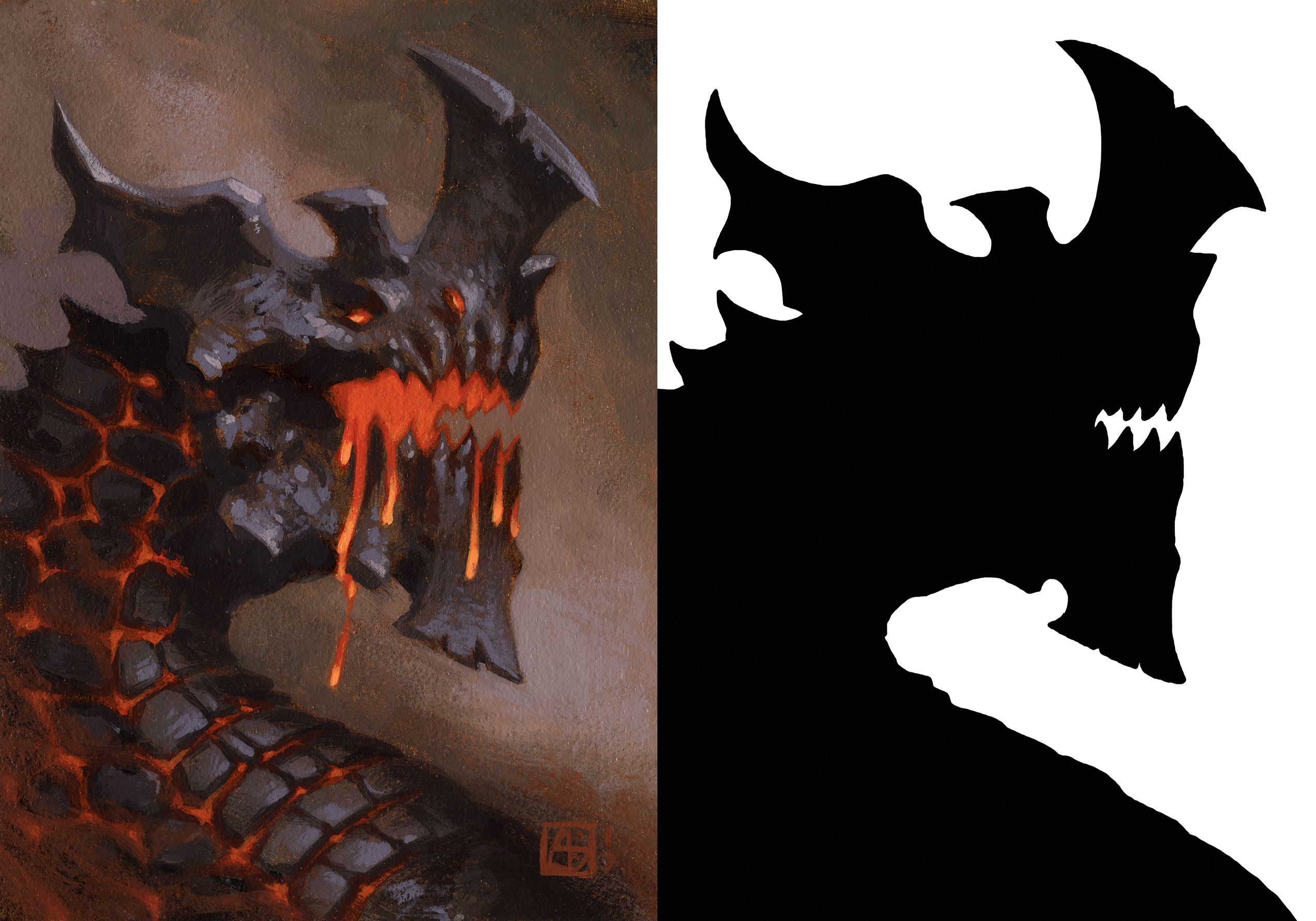
Before you spring into drawing your dragon and get lost in the details, make certain you consider the bigger picture. "For every dragon, arrange the major elements in a way that creates a good silhouette," says Alex Stone, a Brooklyn-based artist whose work has appeared in games such as Dungeons & Dragons and Boom Up.
"This helps ensure the painting will be instantly readable, fifty-fifty when viewed from a distance. It too helps create designs that are more than pleasing to look at from an abstract perspective, even if you lot're aiming for a realistic-looking dragon."
02. Borrow from nature
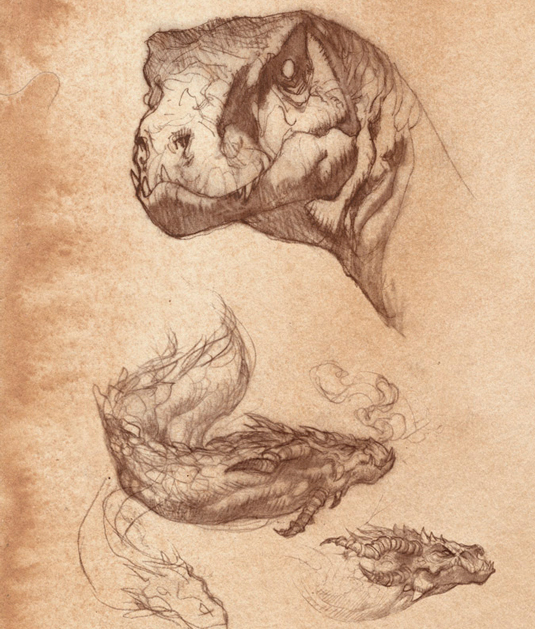
When because how to describe a dragon, accept inspiration from other animals. While dragons accept a largely mythical dimension, they too exist in the real world, and there are many other creatures that tin can provide fresh ideas.
"Crocodiles offering what is maybe the best and nigh threatening example. Of all modern-twenty-four hour period lizards they are some of the about barbarous and terrifying in appearance," suggests Gerard.
Don't restrict yourself to reptiles, nonetheless. "I written report the skull shape of an animate being such every bit a conduct, lion or eel, and combine that with the teeth of an alligator or the nib of a snapping turtle," says Rock. "Anything in nature that looks interesting and inspires me is fair game. Many of my dragons are a handful of real-life animals combined to create something new."
03. Look at humans, also
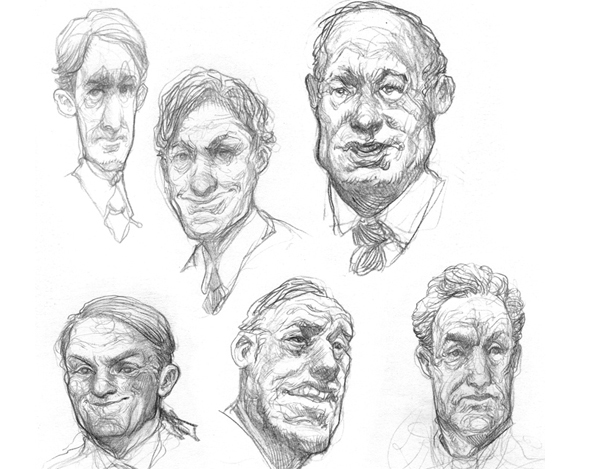
It tin can be helpful to employ human references to inform your dragon's facial expression. "We're searching for a visual rest between a creature that captures our sense of reptilian evil and human intelligence," says Gerard.
"For humans, you could go along a folder of images from the news of sinister-looking political figures – there are some wonderfully sinister politicians out at that place!"
04. Create a backstory for your dragon
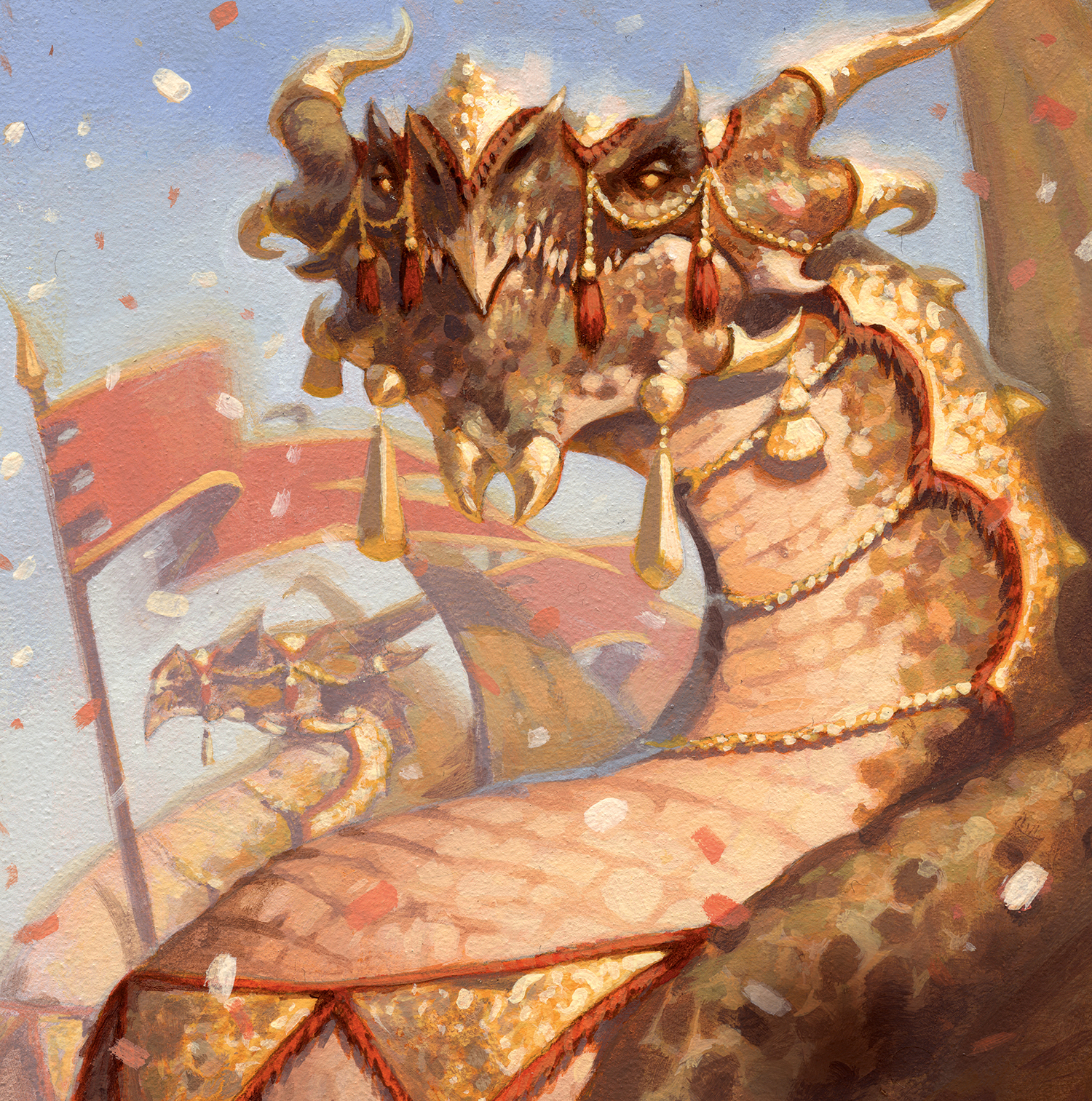
To add even more than layers of interest to your dragon cartoon, consider working up a backstory for your dragon. "Even in a unproblematic portrait, there are things yous tin can add together to give the viewer a better idea of the underlying story," says Stone.
For case, scars hint at battles gone by, and could betoken a violent past. In the painting above, Stone drew inspiration from parade elephants, using flags and decorative dressing to indicate some form of alliance with human masters.
All the smashing literary dragons have a compelling backstory points out studio artist Justin Gerard. "In Tolkien's dragon from The Hobbit, we detect a beast that provides more than than but the mere threat of concrete violence."
"He as well offers a personification of greed – and a distinctly aloof greed at that (he refuses to share or redistribute his wealth, instead pointlessly hoarding it for centuries in his vast cave)," he says. "A wealth of personality tin be poured into a dragon, all the while keeping its sinister features."
05. Give your dragon personality
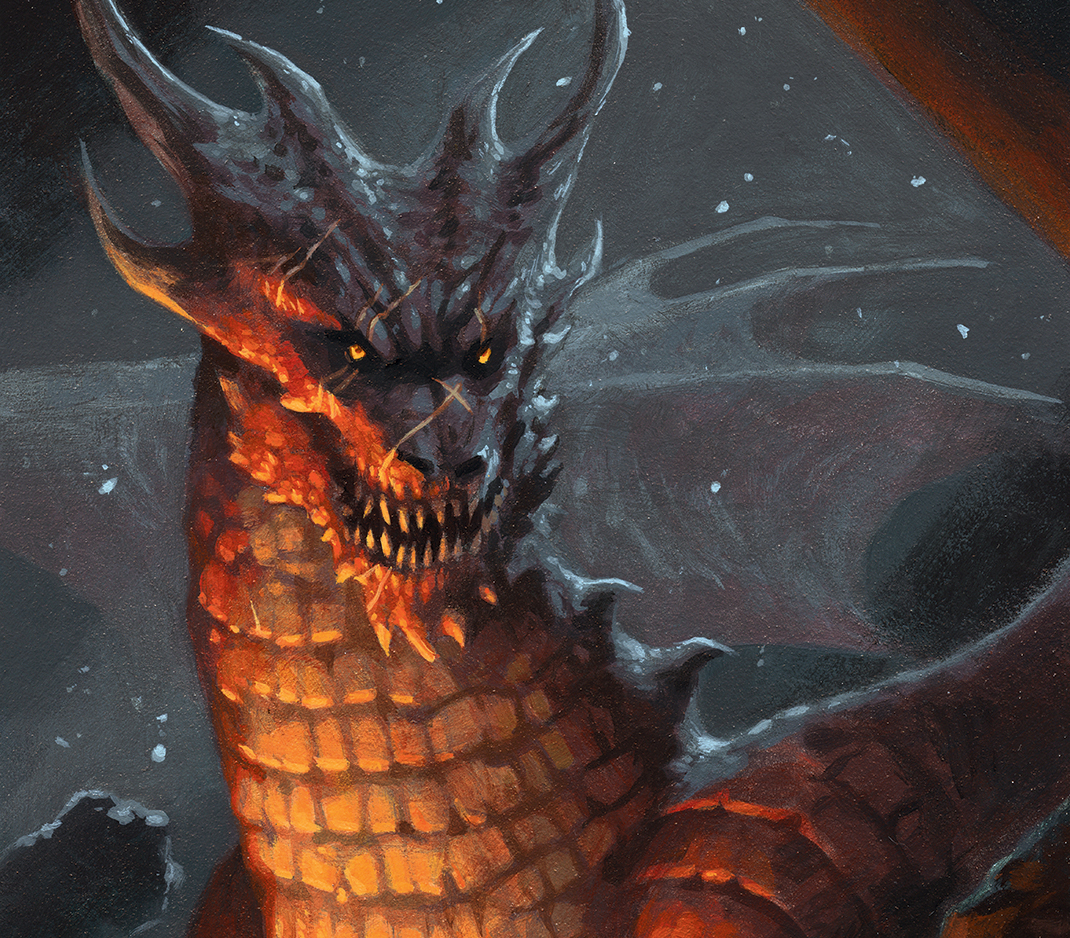
Before you start your dragon cartoon, consider what kind of personality you lot desire your dragon to have. "Frequently I opt for proud, sarcastic, sick-tempered… or some combination of all three," says Stone.
"Keeping this in mind while I work enables me – often subconsciously – to include visual cues to convey this to the viewer. Perhaps through a wicked toothy grin, or a mischievous twinkle of the centre."
06. Utilise references
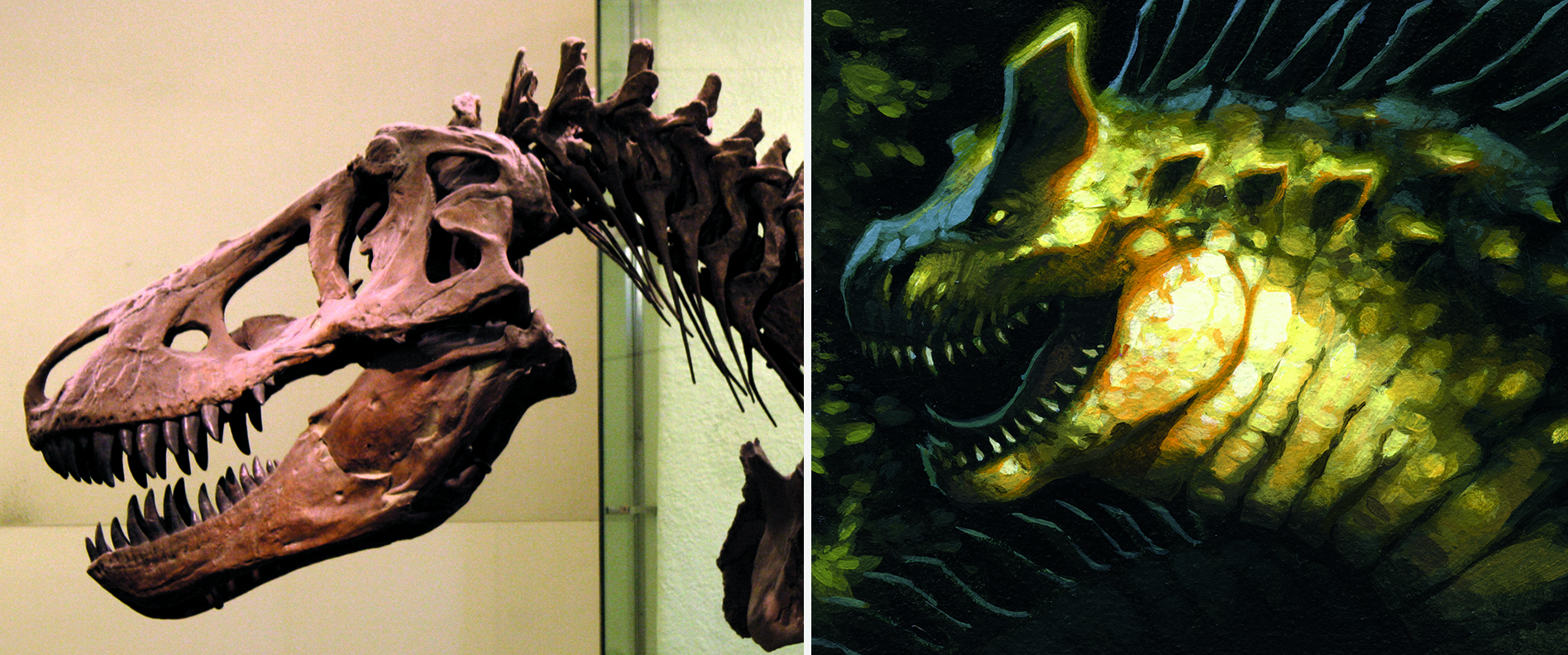
Information technology tin can also help to draw inspiration from real-life creatures: if possible, visit a zoo and make some sketches from life; if not, sketch from photos. Gerard suggests making mental notes about your subject as you depict, to heighten your understanding.
"How far are the eyes from the mouth? How large is the upper jaw compared to the lower?" he says. "As y'all draw these details you're calculation them to a mental library yous'll be able to pull from in hereafter. Information technology also broadens your overall understanding of the structure of living things."
And so, when y'all start to draw your dragon, proceed a collection of relevant photos next to you, to refer to as you work.
When creating the higher up painting, Stone was inspired by dinosaurs such every bit the Tyrannosaurus King, and used a photograph of the creature's skull to inform decisions about the dinosaur'south os structure and anatomy. To supplement this, he referred to images of dappled calorie-free, forests and reptiles, for inspiration for colour, texture and lighting.
07. Remember, dinosaurs aren't dragons
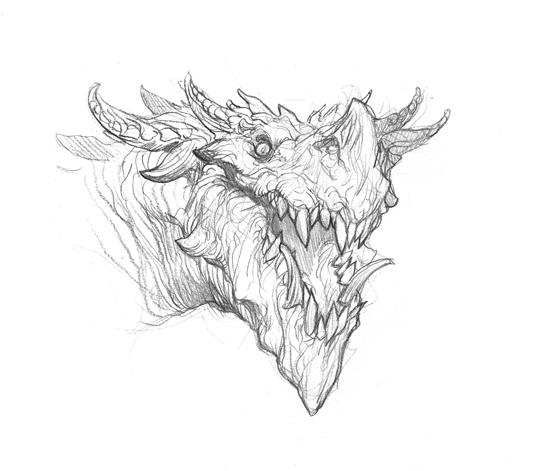
While dinosaurs are cool creatures in their own right, they aren't the same equally dragons. Nevertheless, equally a child JRR Tolkein was told differently. In his essay On Fairy-stories, he makes an interesting case for respecting the unique traits of each.
"I was eager to report nature, really more eager than I was to read most faerie stories," he writes. "But I did not want to exist quibbled into science and cheated out of faeries by people who seemed to assume that by some kind of original sin I should prefer fairy-tales."
08. Consider the setting of your dragon
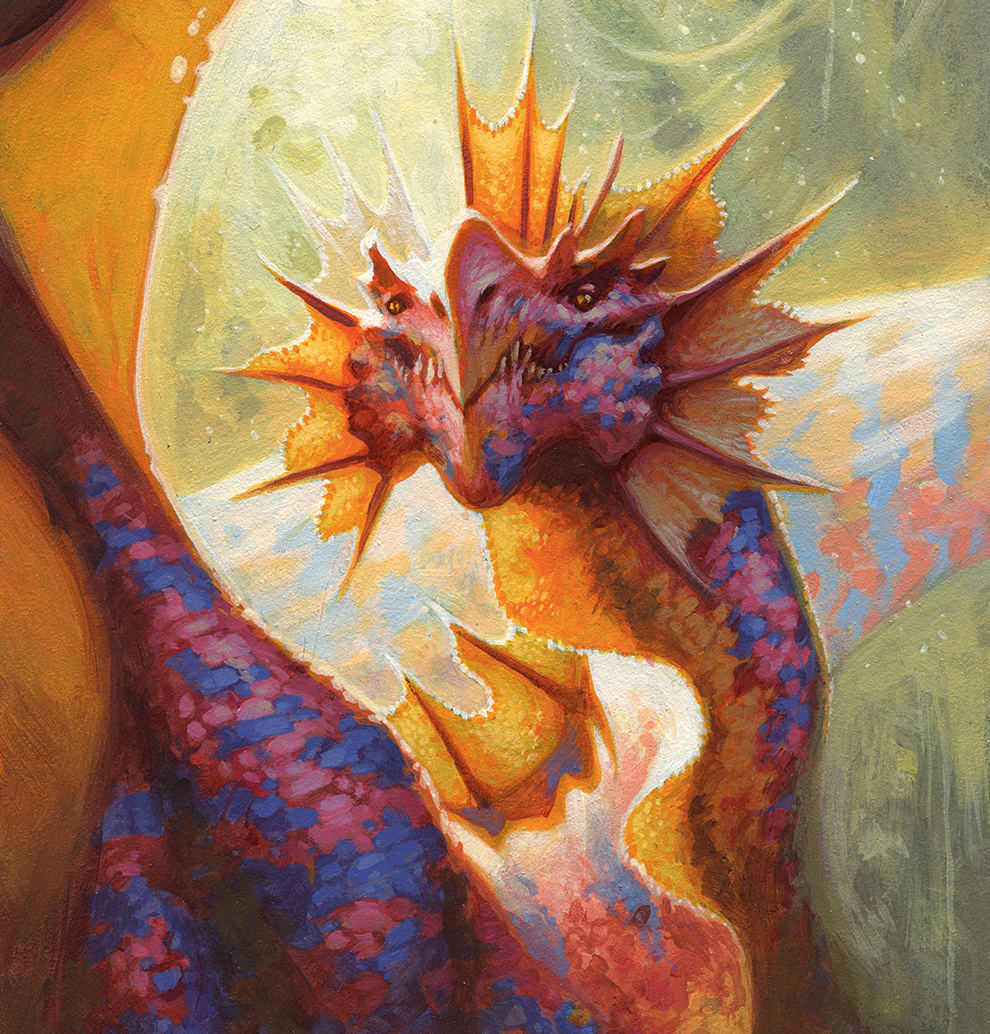
Recall nearly what your dragon'southward surroundings volition look like. This is another element that can exist used to help imply story and add layers of realism and involvement. In the painting above, Stone settled on a tropical setting, which led to a colourful design for the dragon itself, taking inspiration from tropical birds and reptiles.
09. Explore different skin textures
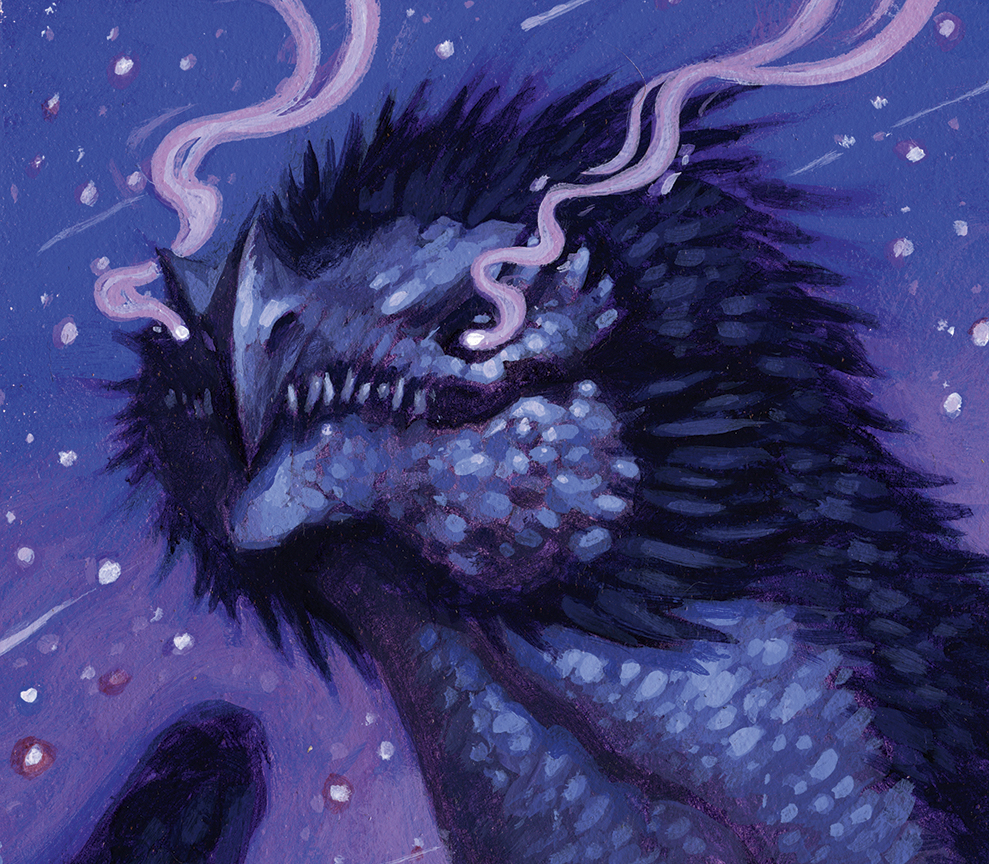
Think of what kind of texture you'd like your dragon to accept. Is it covered in leathery scales, or hard plates, similar armour? "I imagine that a very sometime dragon would accept thick, gnarly scales, like an quondam crocodile, while a younger i might have a smoother, more even pattern," says Rock.
"If you lot'd similar to exist a little unconventional, consider painting a dragon with feathers or fur instead of scales. Y'all can even await to materials like bark and rocks for inspiration. Try unlike things!"
10. Convey scale
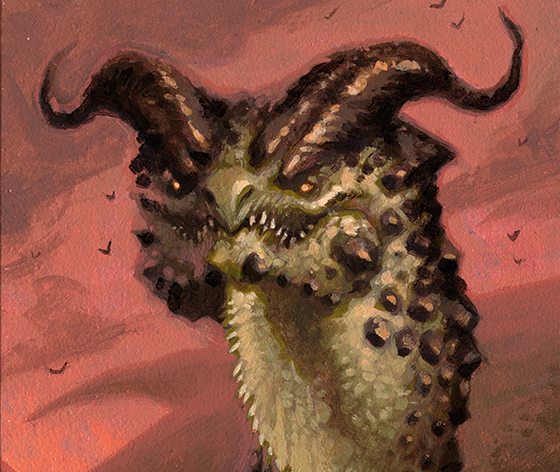
I of import thing to remember when learning how to depict a dragon is that in that location are visual cues you can apply within your image to show its size. I common play a joke on is to include some birds for scale, just you could also use surrounding compages or other props to the same effect.
"Some other concept that tin hands be applied here is eye size," points out Stone. "Larger creatures (think whales or elephants) by and large have small-scale optics relative to their size, and vice versa."
11. Consider your dragon's weight
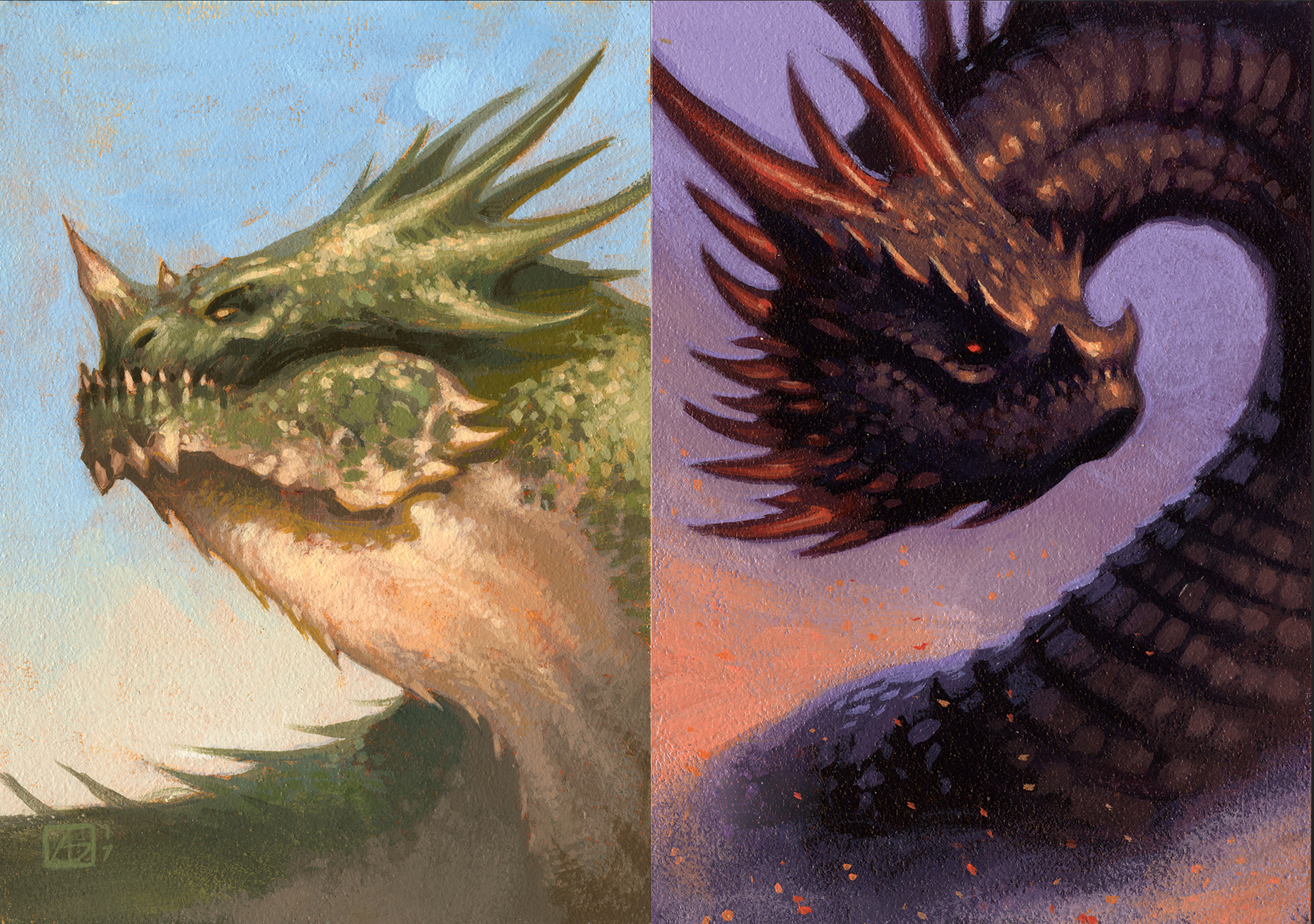
You too want to think about how much mass you want your dragon to have. "When painting a particularly old or powerful dragon, I similar to brand it look heavy," says Stone.
"I have inspiration here from old crocodiles or turtles, with thick scales and flesh that hangs down, particularly around the neck. If I want a dragon to look more graceful then I'll arrive lithe and employ smooth, flowing forms when designing it."
12. Enhance the dragon with dramatic lighting
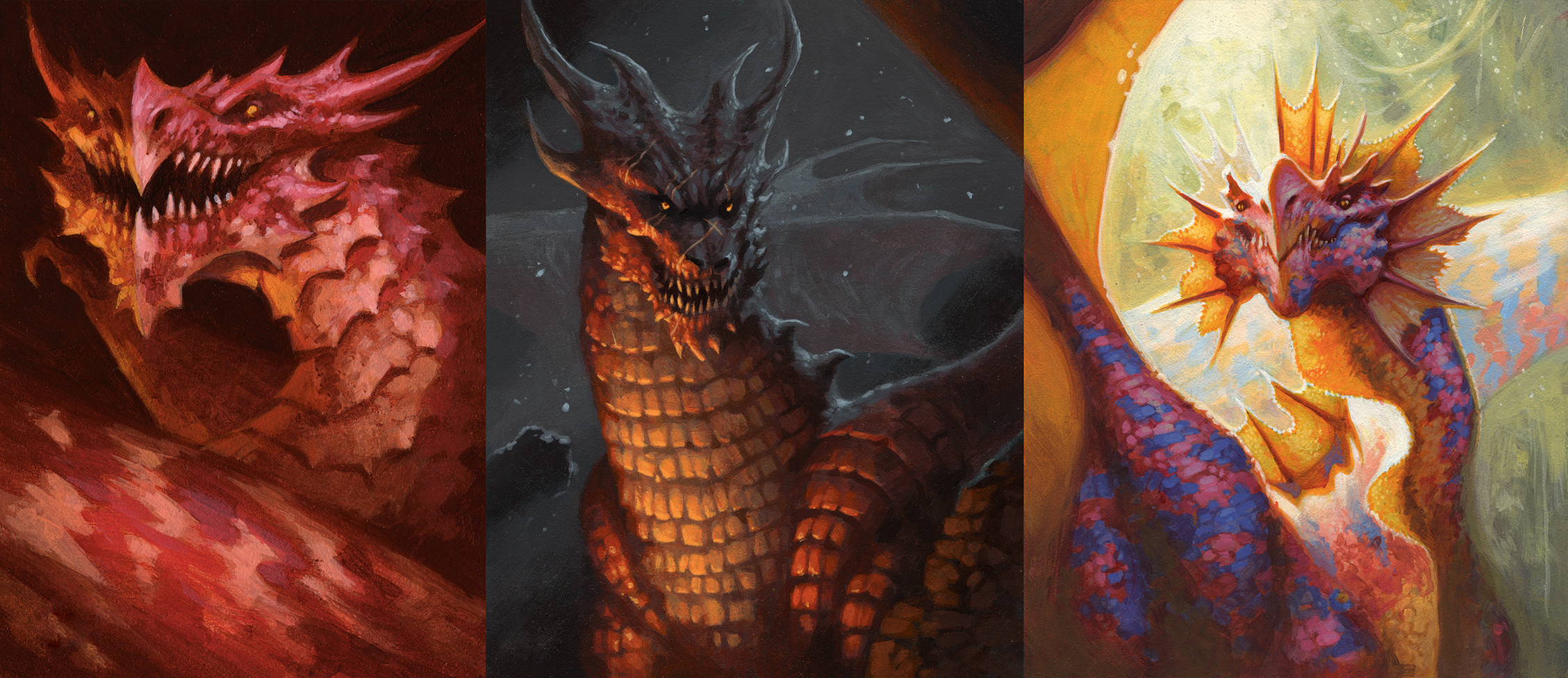
Lighting is a powerful tool, and can transform a painting of a dragon. "Placing a spotlight on the dragon's face will depict the viewer'due south attending, especially if you obscure elements closer to the border of the painting in shadow," explains Rock.
"Lighting tin can also be used to build mood. Lit from below, with its optics obscured in shadow, a dragon will await much more intimidating, whereas rim light tin can brand a dragon wait epic and beautiful."
13. Experiment with atmospheric perspective
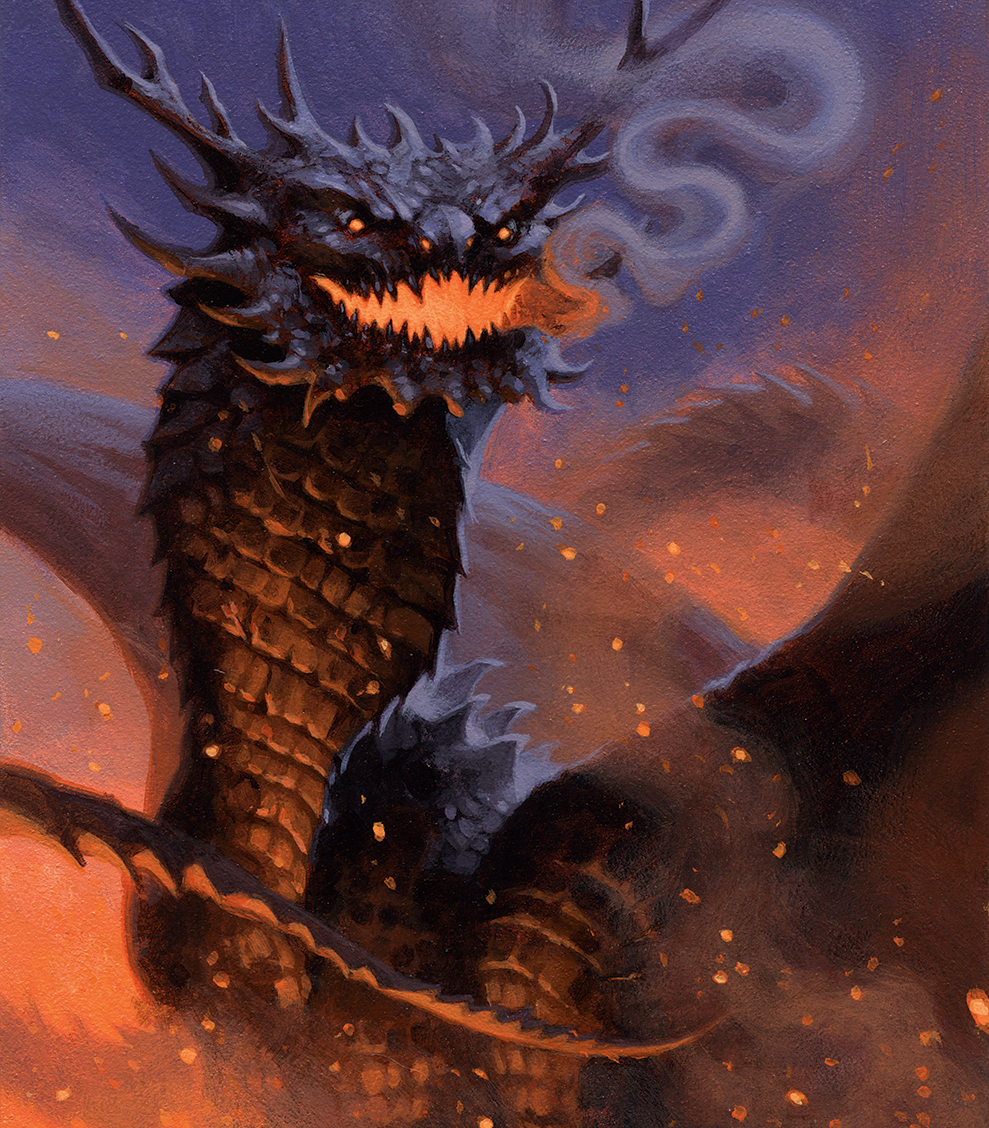
The rule of atmospheric perspective dictates that objects at a altitude will appear hazier than those in the foreground, and option up the colours of the surrounding atmosphere. This can be used to emphasise the size of your dragon – calculation a wing or tail receding into the background, for example, will assistance make your dragon look even bigger.
"An environment with more smoke, dust or wet, such equally fog, will take more pronounced atmospheric perspective, which besides makes it a useful tool to build mood," adds Stone.
14. Use contrasting colours
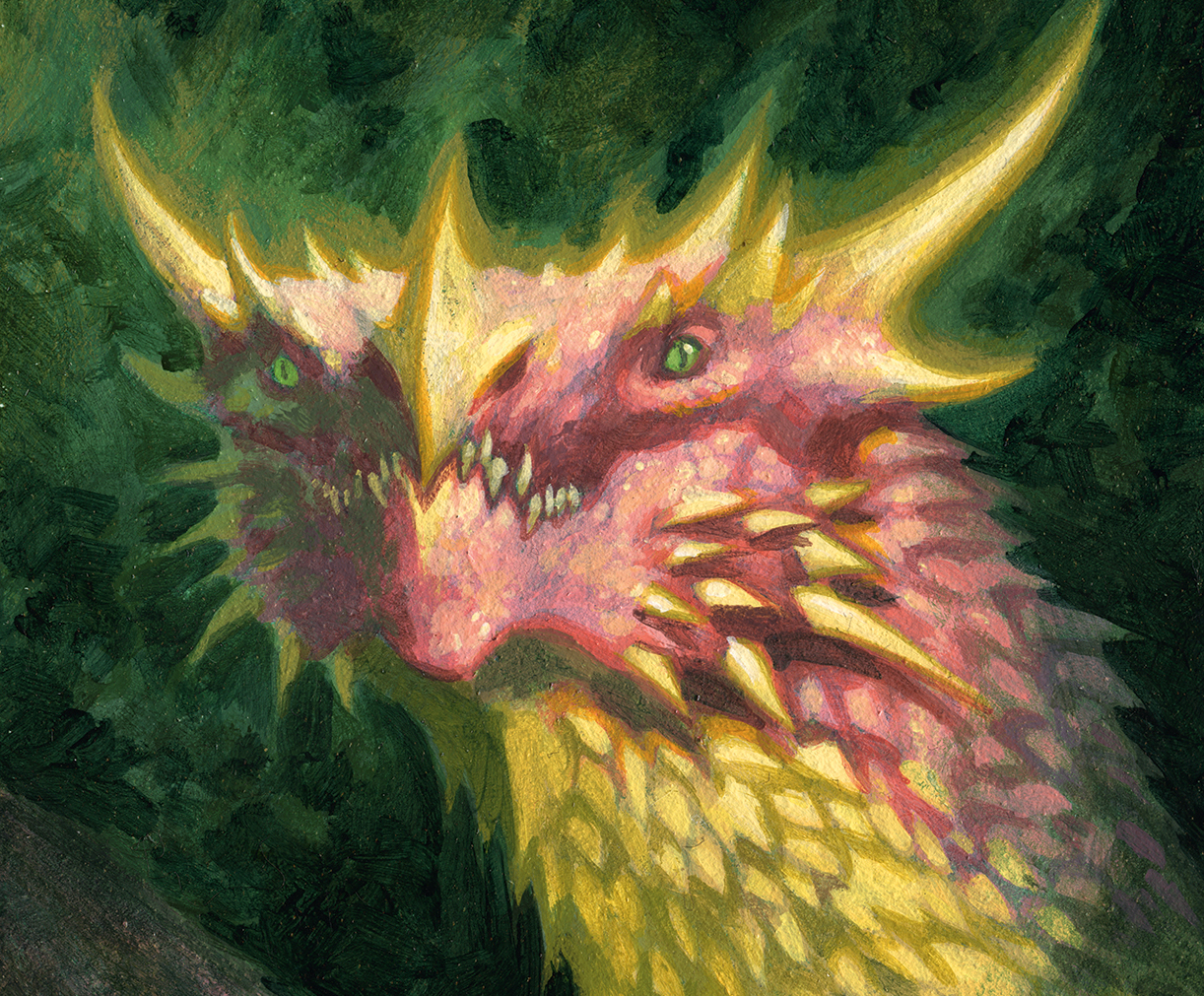
When thinking about colour and value, decide what colour yous want your dragon to exist, then work out a colour scheme for the surroundings that ensures the fauna stands out.
"As a general rule, I choose a value and color for the background that contrasts with the dragon," explains Stone. "For example, if the dragon is night with a lot of cool blues and purples, I'll cull a light background with warmer reds and oranges."
15. Vary the edges in your dragon drawing
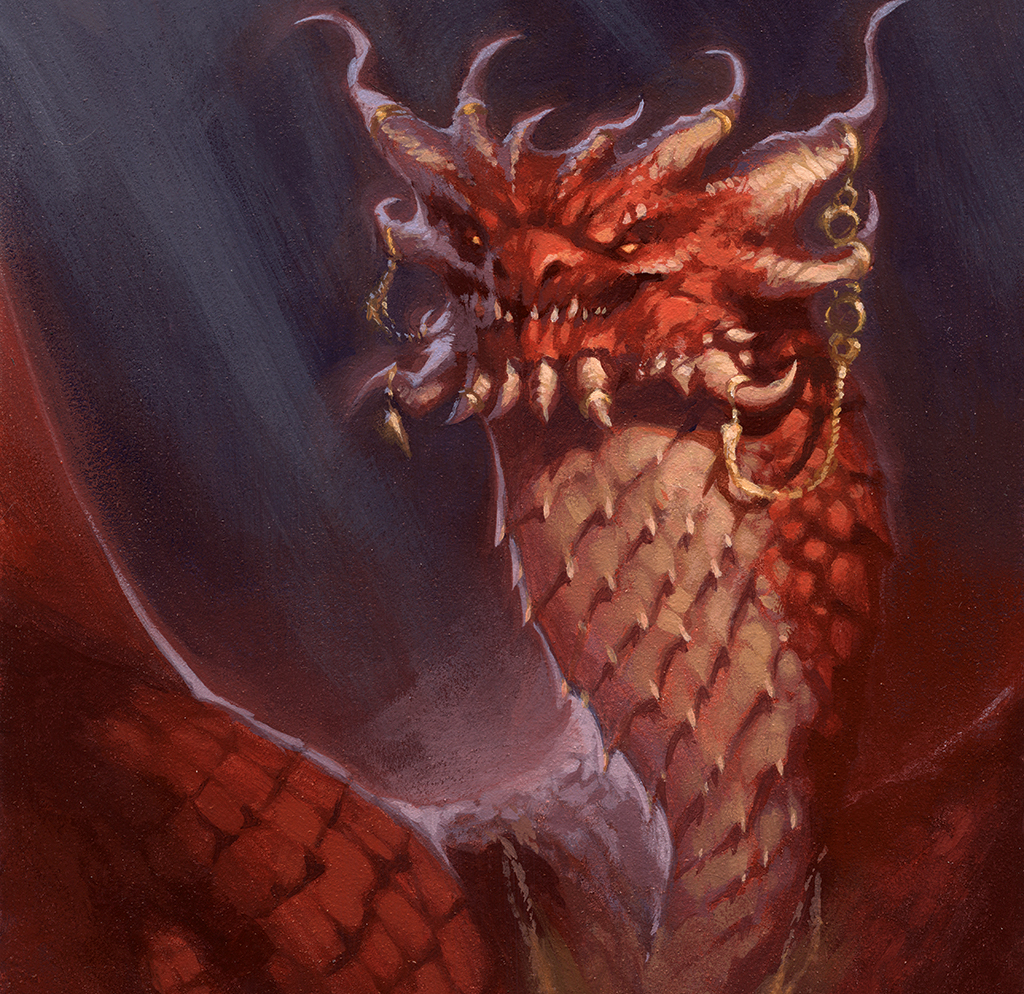
Stone advises using a variety of soft and difficult edges to assistance direct the viewer'south focus and emphasise the feeling of 3D infinite in the epitome. "I proceed the hardest, well-nigh crisp edges effectually the confront and eyes. The closer to the ends of the painting, or farther back in space the object is, the softer the edges get; sometimes they'll be lost entirely," he advises.
"Edges can also exist used to imply movement. A blurry edge on a fly looks similar the dragon has just landed or is about to fly off, and helps to bring the paradigm to life."
16. Take fourth dimension over the dragon's eyes
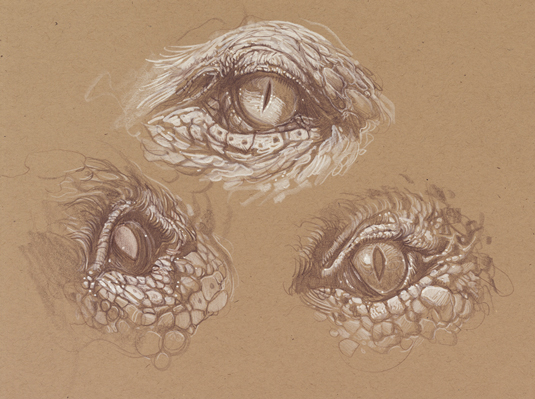
The eyes are often called the window to the soul. When nosotros look at a character in a painting, we will more often than not expect at the optics first – it's a hard-wired instinct for humans. What's more, a lot of data about a dragon's personality can be conveyed through its optics. Then it's important to capture your dragon's eyes correctly.
"Accept some time and brand studies of reptile eyes and human eyes," says Gerard. "Find which ones are the well-nigh expressive. Which ones communicate what y'all're later on the best? Try combining them to achieve something new."
Play with different types of optics until you find the one that captured the personality of your dragon, and the mood you're trying to create. "I detect that including the pupil tends to make them look more than 'man' and intelligent," adds Rock.
"Beady and glowing, with no pupil, and they'll look more than feral, animalistic and threatening. A wide-open up center might indicate inquisitiveness and curiosity, while one one-half-closed might convey arrogance and nonchalance. Placing the optics in shadow tin can make a dragon look very menacing and wicked."
These tips originally appeared in ImagineFX mag, the earth's best-selling magazine for digital artists. Subscribe hither .
Related articles:
- The best iPad art apps for painting and sketching
- The best pencils for colouring, cartoon and sketching
- How to depict a wolf
Related articles
Source: https://www.creativebloq.com/digital-art/8-pro-tips-drawing-dragons-71515935
Belum ada Komentar untuk "How to Draw Scary Simple Monsters Dragon Sketches Art"
Posting Komentar